

Syncing Jira Work Item Workflows with JSM Assets
Discover how integrating Jira Service Management workflows with asset management optimizes ITSM by enhancing automation and data integrity.

Organizations rely heavily on streamlined IT Service Management (ITSM) processes to maintain robust operational health and service excellence. One critical aspect of effective ITSM is the seamless integration of work items lifecycle management with asset management. Jira Service Management (JSM) provides advanced functionalities to merge these processes, significantly enhancing visibility, consistency, and automation.
Understanding the Need for Integration
The modern IT landscape demands instant access to accurate, up-to-date asset information directly linked to service requests and incidents. Without effective integration, teams face challenges such as inconsistent data, manual tracking inefficiencies, and increased resolution times. Integrating JSM workflows with Assets resolves these pain points by creating a unified, automated ecosystem where asset management directly informs and enhances service delivery.

Key Methods for Effective Integration
Integration between Jira work items and Assets can be established through several primary methods:
Native Features
JSM includes several built-in features designed for effortless integration:
-
Assets Custom Fields: Enables the addition of object picker fields to issue or request types, allowing seamless linking to asset objects.
-
Object Schemas: Provides a structured framework for asset data, capturing essential attributes like ownership, location, and status.
-
Object References: Establishes explicit relationships between objects and Jira issues, enhancing traceability and auditability.
Automation Rules
Automation rules streamline workflows by automating asset updates based on defined triggers and conditions:
-
Automatic CI Status Updates:
-
Trigger: Issue transitioned to "Resolved"
-
Condition: Affected CI field is populated
-
Action: Automatically update linked CI status to "Available"
-
-
Asset Assignment Automation:
-
Trigger: Issue created
-
Condition: Reporter has a linked asset in the database
-
Action: Automatically populate the "Affected CI" field
-
-
Auto-Closing Linked Issues:
-
Trigger: Asset object status updated to "Archived"
-
Action: Automatically close related Jira issues to maintain accuracy
-
Workflow Functions
Advanced workflow customizations include:
-
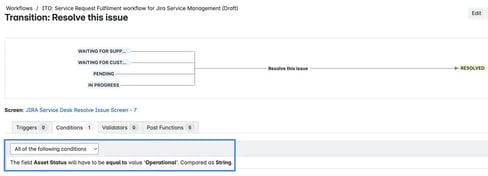
Conditions: Restrict transitions based on asset status, ensuring transitions like "Resolved" only occur if linked assets meet defined criteria.
-
Validators: Ensure required asset fields, such as "Affected CI," are populated before transitions. This validation ensures data integrity and compliance with IT policies.
-
Post Functions: Automatically execute asset data updates during workflow transitions, such as priority escalation or owner notification when critical assets are involved.
Real-World Scenario: Critical Service Escalation
Consider a scenario involving a critical service asset experiencing an issue. Using Jira's integrated workflow and asset management:
-
A user reports an incident linked to a "Critical Service" asset.
-
Workflow conditions detect the critical asset type.
-
A post-function automatically escalates the issue priority to "High."
-
Notifications are sent immediately to asset owners, ensuring rapid awareness and response.
This scenario highlights how integration reduces response time, enhances clarity, and improves service reliability.
Best Practices for Successful Integration
To maximize the benefits of integrating Jira workflows and Assets, consider the following best practices:
-
Clearly define and normalize object schemas and attributes for consistent data.
-
Leverage object references for comprehensive visibility and audit trails.
-
Utilize smart values within automation rules to enhance process efficiency.
-
Implement strict permissions and roles governing asset modification for security and accountability.
-
Regularly review and optimize workflows, conditions, validators, and post-functions to maintain efficiency.

Strategic Benefits of Integration
Integrating asset management with Jira workflows yields numerous strategic advantages, including:
-
Real-time CMDB Updates: Directly reflect asset status changes triggered by service request resolution.
-
Data Consistency: Ensure accuracy between operational service data and asset information.
-
Automated Tracking: Significantly reduce manual data entry and tracking, freeing resources for strategic tasks.
-
Improved Service Visibility: Gain comprehensive insights into asset usage, issue resolution timelines, and infrastructure reliability.
Empowering Your ITSM with Atlas Bench
Leveraging Jira's robust integration capabilities with asset management transforms your ITSM strategy, positioning your organization for greater responsiveness and operational agility. By automating manual processes, maintaining data integrity, and streamlining issue resolutions, your teams can focus on innovation and continuous improvement.
Read next.
Non-Human Identities in Atlassian Cloud: Service Accounts, Tokens, Apps, and Agents
How to govern non-human identities in Atlassian Cloud: service accounts, API tokens, Forge apps, and Rovo agents, each with an owner, scope, and expiry.
October 1, 2026How to Choose an Atlassian Partner for a Jira Cloud Migration
How to choose an Atlassian Solution Partner for a Jira Cloud migration: what to verify, eight questions to ask, red flags, and a shortlist scorecard.
September 30, 2026The Complete Guide to Agent Readiness in Atlassian Cloud
Agent readiness for Atlassian Cloud: the five checks to run before you switch on Rovo agents, from identities and permissions to the off switch.
September 28, 2026How to Review Rovo Agent Access in Jira and Confluence
A step-by-step access review for Rovo agents in Jira and Confluence: who can create them, who can use them, what they can change, and what gets logged.
The blog, weekly.
One email a week with what we published. No drip sequence, and you can leave in a click.