

Organizations today are navigating a growing number of digital tools, data silos, and collaboration challenges. That’s where the Atlassian System of Work comes in, a connected platform designed to simplify operations, reduce tool sprawl, and bring every team together around shared goals.
As an Atlassian Solution Partner, Atlas Bench works closely with clients to consolidate third-party tools into the Atlassian ecosystem. This blog breaks down the core capabilities of the Atlassian platform and highlights where consolidation and integration can deliver significant value.
Watch our Video Overview
What Is the Atlassian System of Work?
Atlassian’s System of Work is more than a collection of tools; it’s a strategy for how modern teams collaborate and deliver outcomes. The system spans project management, development, ITSM, strategy, and knowledge management, all supported by a unified cloud platform.
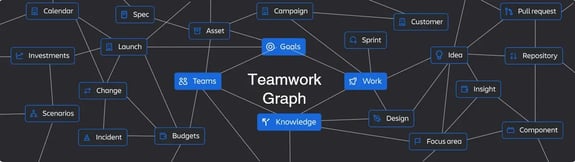
At its core is the Teamwork Graph, a structured data layer that maps relationships between teams, goals, and knowledge. This enables automation, intelligent search, and AI-powered insights across every Atlassian product.
Consolidation Opportunities for Cost Savings
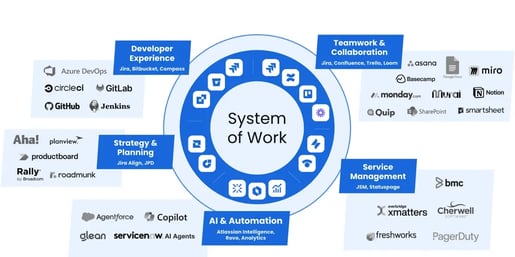
- Many organizations use multiple tools that overlap in functionality.
- Consolidating tools into Jira, Confluence, and Jira Service Management can save $100,000+ annually.
- Atlas Bench helps clients identify tool redundancies across departments and plan efficient transitions.
Jira: The Center of Agile Workflows
Jira supports agile and hybrid methodologies across both technical and business teams. With Atlassian Intelligence, users can:
- Search using natural language.
- Auto-generate tasks from Slack.
- Customize workflows at scale.
Jira integrates deeply with Confluence, Bitbucket, Jira Service Management, and other Atlassian products, creating a streamlined project ecosystem.
Jira Plans: Scaling Beyond the Board
Jira Plans gives teams a unified workspace for managing cross-functional initiatives. You can:
- Visualize work across teams with issue hierarchies.
- Use scenario modeling to test plans before rollout.
- Share plans as links or exports to keep stakeholders aligned.
Jira Align and Atlassian Focus
Jira Align connects execution to strategy. It supports enterprise-wide agile transformation and multi-tiered planning.
Atlassian Focus, a newer tool, tracks OKRs, budget alignment, and progress blockers with real-time visibility and AI-powered summaries. Together, these tools keep strategic and delivery teams working in sync.
Jira Product Discovery
- Central hub for collecting and prioritizing product ideas.
- Visualize priorities with impact vs. effort matrices and timeline views.
- Integrate directly with Jira to move from idea to execution quickly.
Confluence and Whiteboards for Knowledge Management
Confluence is Atlassian’s scalable knowledge base. Teams can:
- Create and collaborate using structured content and AI-generated summaries.
- Replace tools like Notion, Lucidchart, Miro, and FigJam with Confluence Whiteboards.
- Link documentation to Jira, Compass, and JSM for complete traceability.
Jira Service Management (JSM)
JSM connects Dev, IT, and business teams to streamline service delivery. Key features include:
- AI-powered virtual agents for request handling.
- Automated escalations and ticket summaries.
- Real-time incident collaboration with tools like Loom and Slack.
Bitbucket and Compass
Bitbucket offers secure Git hosting with built-in CI/CD and AI-powered development workflows. It connects seamlessly with Jira, JSM, and Confluence.
Compass serves as a component catalog and operational hub, helping teams track dependencies, incidents, and deployments across services.
Loom for Asynchronous Collaboration
Loom allows teams to record, transcribe, and summarize meetings or updates. These videos can be:
- Converted into Jira tickets or Confluence pages.
- Searched via Rovo for faster retrieval and context sharing.
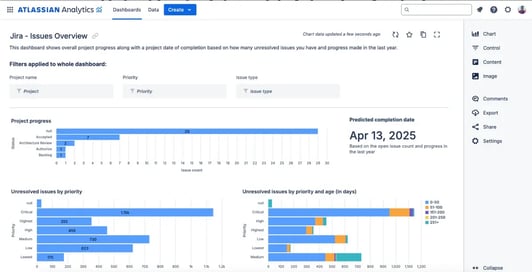
Atlassian Analytics and Data Lake
Analytics provides real-time reporting across Jira, Confluence, and JSM. Highlights include:
- Visual SQL for low-code/no-code reporting.
- AI-driven insights and anomaly detection.
- Seamless integration with Power BI and Tableau.
Atlassian Intelligence, Guard, and Goals
Atlassian Intelligence supports search, automation, and content generation across the platform. Atlassian Guard enhances security with SSO, SCIM, audit logs, and policy control.
Atlassian Goals offers cross-functional goal tracking with automated updates and real-time dashboards integrated across Jira and Confluence.
Rovo: Atlassian’s AI-Powered Assistant
Rovo provides AI-powered search, workflow automation, and no-code agent creation. Teams can:
- Search across Jira, Confluence, Compass, and third-party tools like Figma.
- Automate updates, summarize documents, and personalize responses with metadata.
- Create agents trained on specific projects or documentation.
Why Consolidation Matters Now
Unifying your tools within Atlassian’s System of Work reduces silos, eliminates redundant costs, and strengthens collaboration. With Atlas Bench’s expert guidance, organizations can streamline their operations and scale confidently with AI-powered capabilities at every layer.